
ISO 22000 (FSMS) Certification
Get ISO 22000 Certification with Expert Solutions for ISO 22000 (FSMS) Certification
- Certificate are valid in Tender & Internationally.
- Get Draft ISO 22000 Certification within 1 hour
- We are Partner with 60+ Certification Bodies

300+ राष्ट्रीय और अंतरराष्ट्रीय स्तर पर मान्यता प्राप्त और विश्वसनीय सर्टिफिकेशन बॉडीज़ द्वारा प्रमाणित !
Apply for ISO Certification
Submit Call Back Request for ISO Certification
Trusted on Google & Trustpilot
India’s No.1 Certification Service Provider & International Quality Award Winner


Introduction to ISO 22000 (FSMS) Certification
Food safety has become one of the most important concerns for businesses operating in the food industry. Whether you manufacture food products, process raw materials, package food, transport products, or run a restaurant chain, maintaining food safety is essential for customer trust and business growth.
This is where ISO 22000 Certification plays a crucial role.
The ISO 22000 Standard provides an internationally recognized framework for establishing an effective Food Safety Management System (FSMS). It helps organizations identify food safety hazards, implement preventive controls, comply with regulatory requirements, and consistently deliver safe food products.
Businesses certified to ISO 22000 demonstrate their commitment to food safety, quality, and continuous improvement while meeting both customer expectations and international compliance requirements.
In this guide, you’ll learn everything about ISO 22000 Certification, including its benefits, requirements, certification process, implementation steps, costs, and how Oriental Certification Service (OCS) can support your certification journey.

What is an ISO 22000 Food Safety Management System (FSMS)?
ISO 22000 is an international standard developed by the International Organization for Standardization (ISO) for Food Safety Management Systems (FSMS).
The standard combines:
- HACCP (Hazard Analysis and Critical Control Points)
- Good Manufacturing Practices (GMP)
- Good Hygiene Practices (GHP)
- Risk-based thinking
- Continuous improvement
- Effective communication across the food supply chain
Unlike many food safety standards that focus only on manufacturing, ISO 22000 Certification applies to every organization involved in the food chain.
These include:
- Food manufacturers
- Food processors
- Dairy industries
- Beverage companies
- Restaurants
- Hotels
- Catering services
- Cold storage facilities
- Food transportation companies
- Packaging manufacturers
- Ingredient suppliers
- Agricultural businesses
- Animal feed manufacturers
Why is ISO 22000 Important?
Food contamination can result in:
- Product recalls
- Legal penalties
- Loss of customer trust
- Brand damage
- Financial losses
- Export restrictions
Implementing ISO 22000 Certification helps organizations establish preventive controls instead of reacting after problems occur.
It creates a structured system that continuously monitors food safety risks throughout the supply chain.
Key Objectives of ISO 22000
The primary objectives of the ISO 22000 Standard include:
| Objective | Purpose |
|---|---|
| Food Safety | Prevent contamination and foodborne hazards |
| Risk Management | Identify and control food safety risks |
| Legal Compliance | Meet national and international regulations |
| Customer Satisfaction | Deliver consistently safe products |
| Continuous Improvement | Improve food safety performance over time |
| Supply Chain Communication | Ensure effective communication among suppliers and customers |
Who Needs ISO 22000 Certification?
ISO 22000 Certification is suitable for organizations across the entire food supply chain, regardless of their size.
It is commonly used by:
- Food and beverage manufacturers
- Dairy, meat, seafood, and bakery industries
- Hotels, restaurants, cafés, cloud kitchens, and catering services
- Farms, agricultural producers, and food exporters
- Food warehouses, cold storage, and transportation companies
- Food packaging manufacturers, including plastic, paper, and flexible packaging
Whether you’re a small food business or a large manufacturing company, ISO 22000 helps ensure food safety, regulatory compliance, and customer confidence.
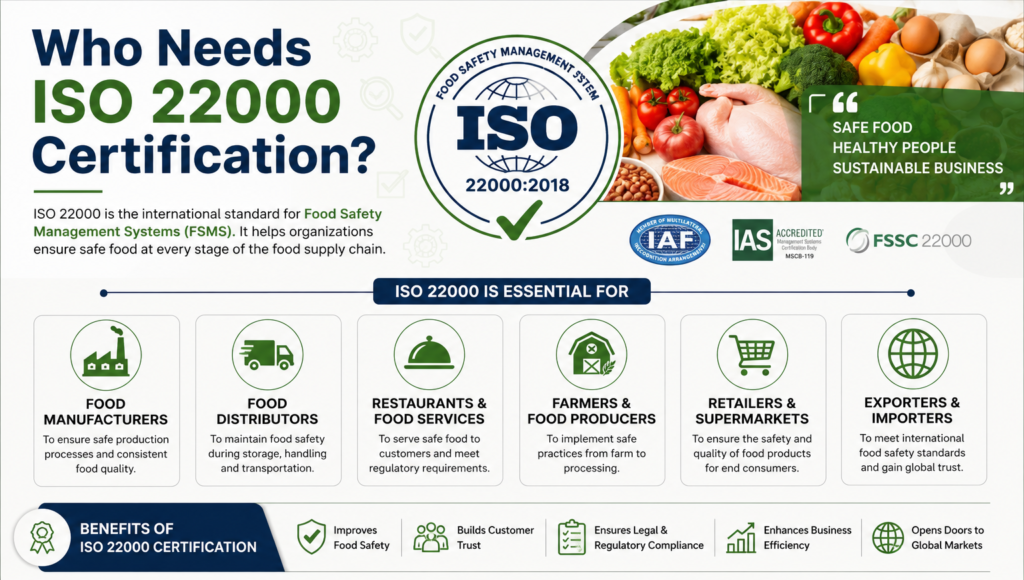
Major Benefits of ISO 22000 Certification
Implementing ISO 22000 Certification offers several advantages that improve food safety and business performance.
- International Recognition: Builds credibility and supports global business opportunities.
- Improved Food Safety: Helps identify and control food safety risks effectively.
- Customer Trust: Increases confidence among customers and business partners.
- Regulatory Compliance: Supports compliance with food safety regulations and legal requirements.
- Operational Efficiency: Streamlines processes, reduces errors, and minimizes waste.
- Risk Management: Enables proactive identification and control of potential hazards.
- Business Growth: Enhances market opportunities and attracts new customers.
- Competitive Advantage: Demonstrates a strong commitment to food safety and quality.
Apply for ISO Certification
Submit Call Back Request for ISO Certification
Understanding HACCP in ISO 22000
A significant component of ISO 22000 Certification is the implementation of HACCP (Hazard Analysis and Critical Control Points).
HACCP helps organizations identify potential biological, chemical, and physical hazards that could affect food safety. It establishes Critical Control Points (CCPs) where these hazards can be prevented, eliminated, or reduced to acceptable levels.
By integrating HACCP into the Food Safety Management System, organizations can proactively manage risks rather than relying solely on end-product inspection.

ISO 22000 Certification and HACCP: What's the Difference?
Many businesses assume ISO 22000 and HACCP are the same, but they serve different purposes.
| ISO 22000 | HACCP |
|---|---|
| International management system standard | Food safety methodology |
| Covers the complete Food Safety Management System | Focuses mainly on hazard control |
| Includes leadership, communication, documentation, and continual improvement | Focuses on Critical Control Points |
| Suitable for the entire food supply chain | Primarily addresses production processes |
| Internationally certifiable | Often implemented as part of broader food safety systems |
Required Documents for ISO 22000 Certification
To obtain ISO 22000 Certification, organizations should maintain the following documents:
| Document | Purpose |
|---|---|
| Food Safety Policy | Defines the organization’s food safety objectives |
| HACCP Plan | Identifies and controls food safety hazards |
| Scope of FSMS | Defines the certification scope |
| SOPs & Work Instructions | Standardizes operational processes |
| Risk Assessment | Evaluates food safety risks |
| Internal Audit Reports | Verifies system effectiveness |
| Management Review Records | Demonstrates top management involvement |
| Corrective Action Records | Tracks issue resolution and improvements |

IAF vs Non-IAF ISO 22000 Certification in India
Understanding the difference between IAF and Non-IAF certification is crucial before applying.
What is IAF?
IAF stands for International Accreditation Forum, an international association that ensures certification bodies operate under globally accepted standards.
IAF vs Non-IAF Certification – Comparison Table
| Feature | IAF Certification | Non-IAF Certification |
|---|---|---|
| Recognition | Globally accepted | Limited recognition |
| Accreditation | Accredited by IAF member bodies | Not under IAF |
| Credibility | High | Moderate |
| Cost | Higher | Lower |
| Acceptance | Required for exports & tenders | Suitable for basic compliance |
| Audit Process | Strict and detailed | Less strict |
| Trust Level | High international trust | Local level acceptance |

Accreditation Bodies (ABs)
Accreditation Bodies ensure that certification bodies operate according to international standards.
| Accreditation Body | Country/Region |
|---|---|
| IAS | United States |
| UKAS | United Kingdom |
| JAS-ANZ | Australia & New Zealand |
Note: Accreditation Bodies (ABs) accredit Certification Bodies (CBs); they do not issue certificates directly.
Popular Certification Bodies (CBs)
Certification Bodies conduct audits and issue ISO 22000 Certification after successful assessment.
| Certification Body | Global Presence |
|---|---|
| SGS | Worldwide |
| Bureau Veritas | Worldwide |
| TÜV SÜD | Worldwide |
| DNV | Worldwide |
| Intertek | Worldwide |
Why Choose Oriental Certification Service (OCS)?
OCS (Oriental Certification Service) is a trusted ISO consultant in India providing complete certification solutions.
Our Advantages:
- Fast and hassle-free process
- Affordable ISO 22000 certification cost
- Expert consultation
- PAN India services
- 100% support and guidance
We ensure that your certification journey is smooth, quick, and successful.
Apply for ISO Certification
Submit Call Back Request for ISO Certification
Disclaimer
Oriental Certification Service (OCS) is a consultancy and facilitation service provider. We assist organizations in documentation, implementation, and coordination with certification bodies.
OCS is NOT a Certification Body (CB) and does not issue ISO certificates directly. Certification is granted by accredited Certification Bodies after successful audit and compliance.