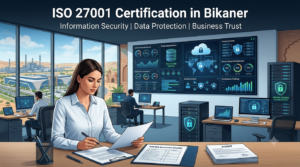

ISO 27001 Certification in Bikaner is becoming relevant for businesses that manage customer information, employee records, financial information, digital systems, software applications and other sensitive data. ISO/IEC 27001 provides a structured framework for establishing, implementing, maintaining and continually improving an Information Security Management System (ISMS). The standard can be applied by organizations of different sizes and sectors.
Bikaner has a diverse industrial and business ecosystem supported by RIICO industrial areas such as Bichhwal, Karni, Karni Extension, IGC Khara, Gajner and other areas administered by the RIICO Bikaner unit.
ISO 27001 Certification at a Glance
| ISO 27001 Area | Details |
|---|---|
| Standard | ISO/IEC 27001:2022 |
| Management System | Information Security Management System (ISMS) |
| Main Purpose | Systematic management of information-security risks |
| Applicable To | Organizations of different sizes and sectors |
| Key Activities | Risk assessment, risk treatment, policies, controls and audits |
| Important Document | Statement of Applicability (SoA) |
| Certification | Conducted through an independent certification process |
| Location | Bikaner, Rajasthan |
What is ISO 27001 Certification?
ISO/IEC 27001 is an international standard for an Information Security Management System (ISMS).
An ISMS helps an organization identify information-security risks and establish appropriate controls, policies and procedures to manage those risks.
The major areas of an ISMS can include:
| Information Security Area | What It Covers |
|---|---|
| Information Security Policies | Security rules and organizational direction |
| Risk Assessment | Identifying information-security risks |
| Risk Treatment | Deciding how identified risks should be managed |
| Access Control | Managing access to systems and information |
| Asset Management | Identifying and managing information assets |
| Data Protection | Protecting sensitive business information |
| Incident Management | Responding to information-security incidents |
| Business Continuity | Maintaining important operations during disruptions |
| Supplier Security | Managing third-party information-security risks |
| Employee Awareness | Training employees about security responsibilities |
| Internal Audit | Evaluating the ISMS |
| Management Review | Reviewing ISMS performance |
| Continual Improvement | Improving information-security processes |
Therefore, ISO 27001 is not simply a cybersecurity technology or software product. It is a management system that helps an organization systematically manage information-security risks.
What is ISO/IEC 27001:2022?
The current international standard is ISO/IEC 27001:2022. It provides requirements for establishing, implementing, maintaining and continually improving an Information Security Management System.
For detailed information about ISO/IEC 27001:2022, visit the ISO official website
The standard requires an organization to consider its information-security environment and risks.
For example:
- What information assets does the organization have?
- What risks could affect those assets?
- Who has access to sensitive information?
- How are security incidents handled?
- How are suppliers evaluated?
- How are employees trained?
- How is information security monitored and improved?
ISO/IEC 27001:2022 also has Amendment 1:2024, which introduced climate-action-related changes.
Why Do Businesses in Bikaner Consider ISO 27001?
Businesses in Bikaner increasingly use computers, cloud applications, accounting software, customer databases, websites, online payment systems and digital communication.
As a result, information security can become an important part of normal business operations.
Organizations may consider ISO 27001 when they want to establish a structured approach to information security and demonstrate their commitment to managing information-security risks.
Businesses interested in information security certification in another major Rajasthan business hub can also read our guide on ISO 27001 Certification in Jaipur.
ISO 27001 for IT Companies in Bikaner
IT companies and technology service providers can handle significant amounts of business and customer information.
An IT company may manage:
| Information Asset | Example |
|---|---|
| Customer Databases | Customer profiles and records |
| Application Credentials | Login credentials and API keys |
| Source Code | Software and application code |
| Cloud Infrastructure | Cloud servers and storage |
| Employee Information | Employee records |
| Business Documents | Contracts and internal documents |
| Backups | Business and application backups |
| Software Systems | Internal and customer-facing applications |
ISO 27001 can help IT organizations establish documented processes for identifying and managing information-security risks.
ISO 27001 for Software and SaaS Companies
Software and SaaS companies may process customer information through their applications and cloud platforms.
An ISMS can cover areas such as:
- Application access
- Developer access
- Source-code protection
- Cloud security
- Database security
- Backup management
- Password management
- Security incident response
- Vendor management
- Employee access
For example, a software company may establish procedures that restrict production database access to authorized employees.
ISO 27001 and Bikaner’s Industrial Ecosystem
Bikaner has an established industrial ecosystem supported by RIICO.
More information about industrial areas and infrastructure is available on the RIICO official website
RIICO information lists several industrial areas under the Bikaner unit.
| RIICO Industrial Area | Business / Information-Security Relevance |
|---|---|
| Bichhwal | Business records, accounting systems and supplier information |
| Bichhwal 2nd | Industrial operations and digital records |
| Karni | Production, employee and business information |
| Karni Extension | Operational and administrative information |
| IGC Khara | Industrial operations and digital business records |
| Gajner | Manufacturing and industrial information |
| Khajuwala | Business and operational records |
| Dungargarh | Industrial and business documentation |
These industrial areas support different types of business activities, creating opportunities for organizations that need structured information-security practices.
Bichhwal Industrial Area
Bichhwal is one of the established industrial areas of Bikaner.
Businesses operating with digital records, accounting systems, customer information or supplier data can consider information-security management as part of their operational controls.
Karni Industrial Area
Karni and Karni Extension are among the industrial areas administered by the RIICO Bikaner unit.
Organizations operating in industrial environments may manage:
- Employee records
- Vendor information
- Financial information
- Production data
- Customer information
- Computer systems
- Business documentation
IGC Khara
IGC Khara is another important industrial area associated with Bikaner.
As businesses become increasingly dependent on digital systems, information-security management can become relevant alongside physical industrial infrastructure.
Gajner Industrial Area
Gajner is an important industrial area near Bikaner.
RIICO information describes the Gajner Industrial Area as covering approximately 1,030 acres, with a proposed Ceramic Park and potential product areas including ceramic, mineral, agro, wool processing, general and large industries.
Organizations operating in such industrial ecosystems may use digital systems for administration, purchasing, finance, employee management, supplier communication and other business functions.
Who Can Get ISO 27001 Certification in Bikaner?
ISO/IEC 27001 can apply to organizations of different sizes and sectors.
| Organization Type | Possible Information-Security Requirements |
|---|---|
| IT Companies | Applications, databases, cloud systems |
| Software Companies | Source code, customer data and infrastructure |
| SaaS Businesses | Customer accounts and cloud platforms |
| Digital Service Providers | Customer and business information |
| Manufacturing Companies | Production and business data |
| Trading Companies | Customer and supplier records |
| Consultants | Client documents and confidential information |
| Educational Organizations | Student and employee records |
| Healthcare Organizations | Sensitive patient and administrative information |
| Financial Businesses | Financial and customer information |
| Logistics Companies | Customer, shipment and operational records |
| Startups | Cloud systems, applications and customer data |
| MSMEs | Business, financial and employee information |
The scope of certification should be clearly defined according to the organization’s activities and information-security requirements.
ISO 27001 for MSMEs in Bikaner
Small and medium-sized businesses may initially assume that information security is only important for large technology companies.
However, an MSME can also store valuable information.
| Information Type | Examples |
|---|---|
| Customer Information | Names, contact details and records |
| Employee Information | Employee documents and records |
| Financial Information | Accounting and financial records |
| Supplier Information | Supplier details and contracts |
| Business Documents | Agreements and internal documents |
| Credentials | Passwords and system access details |
| Payment Information | Online payment-related information |
| Digital Documents | Business files and records |
Therefore, an MSME can develop an ISMS appropriate to its size, operations and risks.
ISO 27001 Certification Process in Bikaner
The certification process generally involves several stages.
| Step | Certification Activity | Main Purpose |
|---|---|---|
| 1 | Initial Assessment | Understand existing information-security practices |
| 2 | Define ISMS Scope | Decide what is covered by the ISMS |
| 3 | Identify Assets | Identify important information assets |
| 4 | Risk Assessment | Identify information-security risks |
| 5 | Risk Treatment | Decide how risks will be managed |
| 6 | Policies & Procedures | Establish documented security processes |
| 7 | Statement of Applicability | Document applicable controls |
| 8 | Employee Training | Build security awareness |
| 9 | Internal Audit | Evaluate the implemented ISMS |
| 10 | Management Review | Review ISMS performance |
| 11 | Certification Audit | Independent evaluation of the ISMS |
1. Initial Assessment
The organization first evaluates its current information-security practices.
This helps identify gaps between existing practices and ISO/IEC 27001 requirements.
2. Define ISMS Scope
The organization determines which business activities, locations, systems and information are included in the ISMS.
3. Identify Information Assets
The organization identifies important information assets.
These can include:
- Computers
- Servers
- Databases
- Applications
- Cloud systems
- Documents
- Websites
- Networks
- Employee information
- Customer information
4. Conduct Risk Assessment
The organization identifies possible information-security risks.
Common examples include:
- Unauthorized access
- Data loss
- Malware
- Phishing
- Password compromise
- Hardware failure
- Human error
- Third-party risks
5. Risk Treatment
After identifying risks, the organization decides how those risks should be treated.
| Risk Treatment Approach | Meaning |
|---|---|
| Reduce | Implement controls to lower the risk |
| Avoid | Stop the activity creating the risk |
| Transfer/Share | Transfer or share certain consequences through appropriate arrangements |
| Accept | Accept the risk where appropriate |
6. Develop Policies and Procedures
The organization prepares relevant information-security policies and procedures.
These may include:
- Information Security Policy
- Access Control Policy
- Password Policy
- Backup Policy
- Incident Management Procedure
- Asset Management Procedure
- Supplier Security Procedure
7. Statement of Applicability
The organization prepares a Statement of Applicability (SoA).
The SoA documents the organization’s selected security controls and explains their applicability within the ISMS.
8. Employee Training
Employees should understand their responsibilities regarding information security.
Training can cover:
- Password security
- Phishing awareness
- Data handling
- Device security
- Access management
- Incident reporting
9. Internal Audit
An internal audit is performed to evaluate whether the ISMS is implemented and maintained effectively.
10. Management Review
Management reviews the ISMS and relevant information-security performance.
11. Certification Audit
An independent certification body evaluates the organization’s ISMS against the applicable ISO/IEC 27001 requirements.
If the requirements are successfully met, certification can be issued by the certification body.
Documents Required for ISO 27001 Certification
The exact documentation depends on the organization’s scope and risk environment.
| Document / Record | Purpose |
|---|---|
| ISMS Scope | Defines the certification scope |
| Information Security Policy | Establishes security direction |
| Risk Assessment | Identifies information-security risks |
| Risk Treatment Plan | Defines how risks will be managed |
| Statement of Applicability | Documents applicable controls |
| Asset Register | Records important information assets |
| Access Control Procedures | Defines access-management practices |
| Incident Management Procedures | Defines incident response |
| Backup Procedures | Documents backup practices |
| Supplier Security Procedures | Addresses supplier-related risks |
| Internal Audit Records | Records internal audit activities |
| Management Review Records | Records management evaluation |
| Training Records | Demonstrates employee awareness activities |
| Corrective Action Records | Tracks identified issues and actions |
Statement of Applicability for ISO 27001
The Statement of Applicability (SoA) is an important part of an ISO 27001 implementation.
It provides a documented view of applicable security controls and their status within the organization’s ISMS.
The organization should ensure that the SoA reflects its actual risks, business activities and selected controls.
ISO 27001 Risk Assessment in Bikaner
Risk assessment is one of the central activities of an ISMS.
A Bikaner business could identify risks related to:
| Asset / Area | Example Risk |
|---|---|
| Customer Database | Unauthorized access |
| Accounting System | Data modification or loss |
| Cloud Platform | Account compromise |
| Email Accounts | Phishing or credential theft |
| Office Computers | Malware infection |
| Employee Devices | Data leakage |
| Business Website | Unauthorized access |
| Software Applications | Security vulnerabilities |
| Physical Documents | Unauthorized access or loss |
For example, if an organization stores customer data in a cloud platform, unauthorized access to that platform can be considered an information-security risk.
The organization can then establish appropriate controls to manage the identified risk.
ISO 27001 Internal Audit
An internal audit helps the organization evaluate whether its ISMS is working according to its planned arrangements and applicable requirements.
| Internal Audit Area | What May Be Reviewed |
|---|---|
| Policies | Whether required policies are established |
| Risk Assessment | Whether risks are identified and reviewed |
| Access Controls | Whether access is appropriately managed |
| Employee Awareness | Whether employees understand security responsibilities |
| Incident Records | Whether incidents are documented and handled |
| Backup Processes | Whether backup arrangements are maintained |
| Supplier Management | Whether supplier risks are considered |
| Corrective Actions | Whether identified issues are addressed |
After that, identified nonconformities or improvement opportunities can be addressed.
ISO 27001 Training in Bikaner
Training can help employees understand their role in maintaining information security.
| Training Area | Main Focus |
|---|---|
| ISO 27001 Fundamentals | Understanding the standard |
| ISMS Awareness | Understanding the organization’s ISMS |
| Risk Management | Identifying and managing risks |
| Internal Auditing | Reviewing ISMS processes |
| Security Controls | Understanding information-security controls |
| Cybersecurity Awareness | Recognizing common security threats |
| Incident Management | Reporting and responding to incidents |
Organizations can choose training according to employee roles and their ISMS requirements.
ISO 27001 Jobs in Bikaner
As organizations establish formal information-security management systems, professionals with relevant knowledge may find opportunities in areas such as:
| Job Area | Typical Work |
|---|---|
| Information Security | Security policies and controls |
| Cybersecurity | Technical security practices |
| IT Administration | Systems and access management |
| Security Compliance | Compliance activities |
| Internal Auditing | ISMS audits |
| Risk Management | Information-security risk assessment |
| ISMS Coordination | Managing ISMS activities |
| Data Protection | Protecting sensitive information |
| IT Governance | IT policies and organizational controls |
Candidates can strengthen their profiles through relevant technical skills, information-security knowledge and practical understanding of ISO 27001 requirements.
ISO 27001 Certification Cost in Bikaner
There is no single fixed price for ISO 27001 certification.
The overall cost can depend on several factors.
| Cost Factor | Why It Matters |
|---|---|
| Organization Size | Larger organizations may require more audit effort |
| Number of Employees | Employee numbers can affect implementation and audit requirements |
| Number of Locations | Multiple locations can increase scope |
| ISMS Scope | Larger scope can require additional work |
| Information Systems | More systems can mean more controls and assessment |
| Existing Controls | Existing security practices can affect implementation work |
| Consultancy | External implementation support may add cost |
| Training | Employee and auditor training may add cost |
| Certification Audit | Certification body audit fees form part of the overall cost |
Therefore, businesses should obtain a detailed quotation based on their actual scope rather than relying on a generic price.
How to Choose an ISO 27001 Certification Provider
Organizations should carefully evaluate certification providers before starting the certification process.
| Factor | What to Check |
|---|---|
| Credentials | Certification body’s qualifications |
| Accreditation | Relevant accreditation status |
| Experience | Experience with similar organizations |
| Audit Process | How certification audits are conducted |
| Certification Scope | What activities can be covered |
| Audit Duration | Expected audit requirements |
| Documentation | Required records and evidence |
| Surveillance | Ongoing certification arrangements |
| Total Cost | Complete certification-related costs |
The certification process should be based on an independent assessment rather than simply purchasing a certificate.
Benefits of ISO 27001 Certification in Bikaner
Organizations implementing ISO 27001 may achieve several business and management benefits.
| Benefit | How It Can Help |
|---|---|
| Structured Security Management | Creates a systematic approach to information security |
| Risk Identification | Helps identify information-security risks |
| Security Awareness | Improves employee understanding |
| Clear Responsibilities | Defines information-security responsibilities |
| Better Documentation | Establishes documented processes |
| Incident Management | Provides structured incident-handling processes |
| Customer Confidence | Can demonstrate a structured security approach |
| Supplier Management | Helps address third-party information risks |
| Continual Improvement | Supports ongoing improvement of the ISMS |
However, ISO 27001 certification should not be treated as a guarantee that every cybersecurity incident will be prevented. Its purpose is to establish and continually improve a systematic approach to information-security risk management.
ISO 27001 and Data Security
Data security is particularly important for organizations that collect, process or store sensitive information.
| Data / Information | Possible Security Consideration |
|---|---|
| Customer Records | Controlled access |
| Employee Data | Appropriate protection and access |
| Financial Records | Restricted access and secure handling |
| Business Contracts | Confidentiality |
| Digital Credentials | Secure management |
| Databases | Access control and monitoring |
| Cloud Systems | Account and access security |
| Internal Documents | Appropriate storage and permissions |
For example, access should be provided according to business requirements, while unnecessary access should be restricted.
ISO 27001 for Bikaner Startups
Startups can also consider information security during their early growth stage.
A startup may already use:
- Cloud hosting
- SaaS applications
- Online payment systems
- Customer databases
- Email platforms
- Remote work tools
- Collaboration software
| Startup Technology | Information-Security Consideration |
|---|---|
| Cloud Hosting | Access and account security |
| SaaS Applications | User permissions |
| Payment Systems | Protection of transaction-related information |
| Customer Database | Controlled access |
| Phishing and account security | |
| Remote Work | Device and access management |
| Collaboration Tools | Information sharing and permissions |
Building appropriate security processes early can help create a more organized approach to information management.
Frequently Asked Questions
What is ISO 27001 Certification in Bikaner?
ISO 27001 Certification in Bikaner refers to certification of an organization’s Information Security Management System against the requirements of ISO/IEC 27001.
Is ISO 27001 only for IT companies?
No. ISO/IEC 27001 can apply to organizations across different sectors and sizes.
What is the current ISO 27001 standard?
The current standard is ISO/IEC 27001:2022. It also has Amendment 1:2024 concerning climate-action-related changes.
Is ISO 27001 useful for MSMEs?
Yes. MSMEs can use an ISMS to systematically manage information-security risks according to their business activities and requirements.
How long does ISO 27001 certification take?
The timeframe varies according to the organization’s size, scope, existing controls, documentation and implementation readiness.
Is ISO 27001 certification mandatory?
ISO 27001 is not universally mandatory for every organization. However, certain customers, contracts, regulatory environments or business requirements may make formal information-security controls important.
Can a Bikaner manufacturing company get ISO 27001?
Yes. ISO/IEC 27001 is not restricted to software or IT organizations. Manufacturing companies can also establish an ISMS for the information they manage.
What is an ISMS?
ISMS stands for Information Security Management System. It is the management framework used to systematically manage information-security risks and continually improve information-security practices.
Conclusion
ISO 27001 Certification in Bikaner can provide a structured framework for organizations that want to manage information-security risks more systematically. From IT businesses and startups to manufacturing companies and MSMEs, organizations can develop an ISMS based on their specific information assets, risks and operational requirements.
Bikaner’s industrial ecosystem includes established and developing RIICO areas such as Bichhwal, Karni, IGC Khara and Gajner, creating a broad business environment where information-security practices can become increasingly relevant.
By implementing appropriate policies, risk assessment, security controls, employee awareness, internal audits and continual improvement, businesses can build a more organized approach to protecting the information they handle.