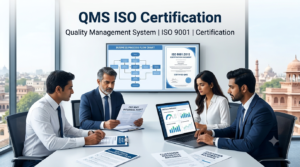

QMS ISO Certification is a formal certification process used to demonstrate that an organization’s Quality Management System (QMS) meets the requirements of an applicable ISO standard. For general quality management, ISO 9001 is the internationally recognized standard used for certification. The current edition is ISO 9001:2026, published by ISO on 16 September 2026.
A QMS helps an organization manage its processes, customer requirements, quality objectives, records and continual improvement activities. Therefore, certification is not simply about obtaining a certificate; it involves establishing and maintaining a working management system.
QMS ISO Certification at a Glance
| Factor | Details |
|---|---|
| QMS | Quality Management System |
| Main ISO Standard | ISO 9001:2026 |
| Purpose | Structured quality management |
| Applicable To | Organizations of different sizes and sectors |
| Certification | Independent conformity assessment |
| Main Areas | Processes, customer requirements, quality and improvement |
| Audit | Required as part of certification |
| Documentation | Based on the organization’s QMS |
| Internal Audit | Used to evaluate the QMS internally |
| Certification Body | Conducts the certification assessment |
ISO states that ISO 9001 is designed for organizations of all sizes and sectors and defines requirements for establishing, implementing, maintaining and continually improving a QMS.
What Is a Quality Management System?
A Quality Management System, commonly called a QMS, is a structured way for an organization to manage processes related to quality.
It can include:
- Customer requirements
- Business processes
- Quality objectives
- Supplier management
- Operational controls
- Customer feedback
- Internal audits
- Corrective actions
- Management reviews
- Continual improvement
The exact QMS structure depends on the organization’s activities, size, products and services.
For example, a manufacturing company may focus on production, inspection and supplier processes. A service company may focus more on service delivery, customer requirements and complaint handling.
What Is ISO 9001?
ISO 9001 is the ISO standard that specifies requirements for a Quality Management System.
ISO 9001:2026 is the current edition. It was published on 16 September 2026 and replaced ISO 9001:2015.
ISO explains that ISO 9001 helps organizations improve performance, meet customer expectations and demonstrate their commitment to quality.
Is QMS ISO Certification Mandatory?
QMS ISO Certification is not automatically mandatory for every business.
However, certification may become relevant when:
- A customer requests ISO certification.
- A contract specifies certification.
- A tender includes an ISO requirement.
- A business wants to demonstrate its QMS to external parties.
- A supply-chain requirement includes certification.
Therefore, businesses should check the exact requirement applicable to their contract, customer or tender.
QMS ISO Certification and ISO 9001
For general quality management, ISO 9001 is the main ISO standard used for QMS certification.
The relationship can be understood simply:
QMS → Quality Management System
ISO 9001 → Requirements for the QMS
Certification → Independent assessment of conformity
In other words, an organization first establishes and operates its QMS. Then, if it wants certification, an independent certification body assesses the system against the applicable ISO 9001 requirements.
ISO also notes that certification is not mandatory and that certification is one way to demonstrate commitment to consistently delivering quality products or services.
Who Can Apply for QMS ISO Certification?
ISO 9001:2026 can be used by organizations regardless of size, sector or activities.
This can include:
| Organization | Possible QMS Focus |
|---|---|
| Manufacturer | Production and quality control |
| IT Company | Service delivery and customer requirements |
| Consultant | Service processes and customer satisfaction |
| Trader | Purchasing and supplier management |
| Service Provider | Service delivery and complaints |
| Startup | Process development and quality control |
| MSME | Business processes and continual improvement |
| Educational Organization | Service and administrative processes |
| Construction Business | Project and supplier processes |
The actual QMS should reflect the organization’s own activities rather than copying another company’s system.
Main Elements of a QMS
A practical QMS can include several connected areas.
Customer Requirements
The organization needs to understand what customers require from its products or services.
For example, requirements may include:
- Product specifications
- Delivery requirements
- Service conditions
- Communication requirements
- Applicable legal requirements
Process Management
Processes should be defined and managed according to the organization’s activities.
Examples include:
- Sales
- Purchasing
- Production
- Service delivery
- Inspection
- Delivery
- Customer support
Quality Objectives
Organizations can establish measurable quality objectives that support their business and QMS.
For example:
- Reduce customer complaints
- Improve delivery performance
- Reduce process errors
- Improve customer satisfaction
Monitoring and Measurement
Organizations can monitor relevant processes and results.
This information can then be used to identify areas that require improvement.
Continual Improvement
A QMS should support ongoing improvement.
Therefore, organizations can use audits, customer feedback, performance data and corrective actions to identify improvement opportunities.
QMS ISO Certification Process
The certification process can vary depending on the organization and certification body. However, a typical process includes the following stages.
Step 1: Define the Certification Scope
First, identify the products, services, locations and activities that will be covered by certification.
The scope should accurately represent the organization’s activities.
Step 2: Understand ISO 9001 Requirements
Next, the organization should understand the applicable requirements of ISO 9001:2026.
This helps identify what needs to be established or improved.
Step 3: Conduct a Gap Assessment
The organization can compare its current processes with the applicable QMS requirements.
As a result, gaps and improvement areas become easier to identify.
Step 4: Develop the QMS
The organization establishes processes and controls needed for its QMS.
Documentation should support the actual operation of the business.
Step 5: Implement the QMS
Employees should use the defined processes in daily operations.
A QMS should not exist only as documents prepared for an audit.
Step 6: Conduct Internal Audit
An internal audit helps the organization review its QMS and identify areas that require attention.
Step 7: Management Review
Management reviews relevant QMS performance information and improvement needs.
Step 8: Certification Audit
Finally, an independent certification body conducts the certification assessment.
If the applicable requirements are met, certification can be issued according to the certification body’s process.
Documents Used in QMS ISO Certification
The exact documentation depends on the organization and its processes.
Common examples can include:
- Quality policy
- Quality objectives
- Process information
- Customer requirement records
- Supplier records
- Operational records
- Monitoring records
- Customer feedback
- Nonconformity records
- Corrective action records
- Internal audit records
- Management review records
However, organizations should avoid creating unnecessary documents simply to increase paperwork.
The documentation should support effective QMS operation.
Internal Audit in a QMS
An internal audit is an important part of maintaining a QMS.
It can help an organization determine whether its processes:
- Are implemented as planned
- Meet applicable requirements
- Are producing expected results
- Have identified areas for improvement
For example, an organization may audit its purchasing process to check supplier evaluation, purchase requirements and relevant records.
After the audit, identified issues can be addressed through appropriate corrective actions.
Management Review
Management review provides an opportunity for leadership to evaluate the performance of the QMS.
Information reviewed may include:
- Customer feedback
- Quality objectives
- Audit results
- Process performance
- Nonconformities
- Corrective actions
- Supplier performance
- Improvement opportunities
Therefore, management review connects QMS performance with organizational decision-making.
QMS ISO Certification Audit
The certification audit is performed by an independent certification body.
The auditor may examine:
- QMS processes
- Records
- Employee understanding
- Operational activities
- Customer requirements
- Internal audits
- Management review
- Corrective actions
- Performance information
The exact audit arrangements depend on factors such as the organization’s size, scope, complexity and applicable certification requirements.
QMS ISO Certification Body
A certification body performs the independent assessment of the organization’s QMS.
Businesses should check the certification body’s credentials and whether its accreditation covers the relevant certification scope when accredited certification is required.
In India, NABCB provides accreditation for certification bodies under management-system schemes, including Quality Management Systems based on ISO 9001.
Accredited Certification vs Certification
These terms should not be confused.
| Term | Meaning |
|---|---|
| QMS | Organization’s quality management system |
| ISO 9001 | Standard containing QMS requirements |
| Certification Body | Organization conducting certification assessment |
| Accreditation Body | Body that assesses the competence of certification bodies |
| Accredited Certification | Certification performed under the applicable accreditation framework |
Therefore, businesses should identify what type of certification their customer, contract or tender actually requires.
QMS ISO Certification Cost
There is no single fixed price for QMS ISO Certification.
Cost can depend on:
- Number of employees
- Certification scope
- Number of locations
- Complexity of operations
- Audit time
- Certification body
- Consultancy support
- Travel requirements
- Surveillance arrangements
A small organization with a simple scope may have different certification requirements from a large organization operating across multiple locations.
For this reason, businesses should request a complete quotation and check what is included.
How to Reduce QMS Certification Costs
Businesses can manage certification expenses through proper planning.
Use Existing Processes
Existing effective business processes can often form part of the QMS.
Define the Scope Clearly
An accurate scope helps prevent unnecessary complexity.
Prepare Employees
Employees should understand the processes relevant to their responsibilities.
Conduct an Internal Audit
Finding issues before the certification audit can help the organization prepare.
Compare Complete Quotations
Compare audit, certification and recurring costs rather than only the initial price.
Avoid Unnecessary Documentation
A QMS should be practical and appropriate for the organization.
ISO 9001:2026 and QMS Certification
ISO 9001:2026 is the current edition of the standard.
The new edition was published on 16 September 2026. ISO says the revision focuses on improved clarity, quality culture, leadership and clearer consideration of risks and opportunities.
Organizations already using ISO 9001:2015 should review the transition requirements with their certification body.
ISO’s guidance says organizations should build on existing systems and processes rather than completely replace their QMS.
ISO 9001:2015 vs ISO 9001:2026
| Area | ISO 9001:2015 | ISO 9001:2026 |
|---|---|---|
| Status | Withdrawn | Current edition |
| Edition | Fifth | Sixth |
| Publication | 2015 | 2026 |
| QMS | Yes | Yes |
| Continual Improvement | Yes | Yes |
| Current Certification Standard | No | Yes |
| Transition | Organizations should consult certification body | Current edition |
ISO confirms that ISO 9001:2015 has been withdrawn and replaced by ISO 9001:2026.
Benefits of QMS ISO Certification
ISO 9001 identifies several potential benefits of implementing a quality management system.
These can include:
- Better process management
- Improved customer confidence
- More consistent operations
- Better complaint handling
- Continual improvement
- More structured quality objectives
- Improved decision-making
ISO reports that ISO 9001 is used by organizations across many sectors and has more than one million certificates issued across 189 countries.
However, certification does not automatically guarantee better business results. The outcome depends on how effectively the organization implements and maintains its QMS.
QMS ISO Certification for MSMEs
MSMEs can use a QMS to organize their business processes without creating a system that is unnecessarily complicated.
For a small organization, the QMS may focus on:
- Customer requirements
- Supplier management
- Service or production processes
- Quality monitoring
- Complaints
- Internal audits
- Corrective actions
- Management review
The system should be appropriate to the organization’s size and activities.
QMS ISO Certification for GeM and Government Tenders
Some government tenders or procurement requirements may specify ISO certification.
However, ISO 9001 certification does not automatically qualify an organization for every government tender.
Each tender can have its own:
- Technical requirements
- Financial requirements
- Certification requirements
- Product specifications
- Experience requirements
- Scope requirements
Therefore, businesses should review the specific tender document before assuming that QMS certification is mandatory.
You can also read our detailed guide on ISO 9001 for GeM Tender.
Common QMS Certification Mistakes
Businesses can face problems when they treat certification as only a documentation exercise.
Common mistakes include:
Creating Documents That Are Not Used
Documents should reflect actual business processes.
Ignoring Employee Training
Employees need to understand the processes relevant to their work.
Choosing an Unverified Certification Provider
Businesses should verify certification arrangements and applicable accreditation requirements.
Preparing Only Before the Audit
A QMS should operate continuously rather than only during an audit.
Using an Incorrect Scope
The certification scope should accurately describe the organization’s activities.
Focusing Only on the Certificate
The QMS itself should provide value through controlled processes and continual improvement.
QMS ISO Certification Checklist
Before starting certification, businesses can review this checklist:
| QMS Certification Checklist |
|---|
| Certification scope defined |
| Applicable ISO requirements understood |
| Existing processes reviewed |
| QMS implemented |
| Employees trained |
| Relevant records maintained |
| Internal audit completed |
| Management review completed |
| Certification body selected |
| Certification audit scheduled |
Frequently Asked Questions
What is QMS ISO Certification?
QMS ISO Certification is an independent certification of an organization’s Quality Management System against an applicable ISO standard, commonly ISO 9001 for general quality management.
Is QMS the same as ISO 9001?
No. A QMS is the organization’s management system for quality. ISO 9001 is the standard that specifies requirements for a QMS.
Which ISO standard is used for QMS certification?
For general quality management, ISO 9001 is the applicable standard. The current edition is ISO 9001:2026.
Is ISO 9001:2026 the latest edition?
Yes. ISO 9001:2026 was published on 16 September 2026 and replaced ISO 9001:2015.
Is QMS ISO Certification mandatory?
No. ISO 9001 certification is not mandatory for every organization. However, specific customers, contracts or tenders may require it.
Can an MSME get QMS ISO Certification?
Yes. ISO 9001:2026 is designed for organizations of different sizes and sectors.
Does QMS ISO Certification require an audit?
Yes. Certification involves assessment by an independent certification body.
Can a company implement QMS without certification?
Yes. An organization can implement a QMS without obtaining third-party ISO 9001 certification.
How much does QMS ISO Certification cost?
There is no universal price. The cost depends on factors such as organization size, scope, locations, complexity, audit time and certification provider.
Does ISO 9001 certification guarantee a government tender?
No. Tender qualification depends on the specific requirements stated in the tender document.
Conclusion
QMS ISO Certification provides a structured approach for organizations that want to establish, maintain and independently assess a Quality Management System.
For general quality management, ISO 9001:2026 is the current international standard. It applies to organizations of different sizes and sectors and supports structured processes, customer focus and continual improvement.
Before starting certification, an organization should define its scope, understand the applicable requirements, implement its QMS, conduct internal checks and select an appropriate certification body.
The focus should remain on operating an effective QMS rather than obtaining a certificate alo